


[Mar 15, 2026] B2C-Commerce-Developer Exam Dumps - 100% Marks In B2C-Commerce-Developer Exam!
Exam Dumps Use Real Salesforce Developers Dumps With 208 Questions!
Salary of Salesforce B2C-Commerce-Developer: Salesforce Accredited B2C Commerce Developer Exam
The average Salary of a B2C Commerce Developer Certified Expert in:
- United States - 75,500 USD
- England - 54000 Pounds
- India - 73000 INR
- Europe - 62000 EURO
NEW QUESTION # 59
Given a file in a plug-in cartridge with the following code:
'use strict':
Var base = module.superModule;
Function applyCustomCache (req,res,next){
res.CachePeriod = 6; //eslint-disable-line no-param-reassign
res.cachePeriodUnit = 'hours') //eslint-disable-line no-param-reassign
next();
}
Module.exports = base;
Module.exports.applyCustomCache = applyCustomCache;
What does this code extend?
- A. A model
- B. A controller
- C. A middleware script
- D. A decorator
Answer: C
Explanation:
The provided code snippet demonstrates the extension of a middleware script in Salesforce B2C Commerce.
Middleware scripts are used to modify or enhance the functionality of existing server-side logic, often by intercepting requests and responses to add additional processing steps or modify the response properties. In this snippet, the script adjusts caching properties (CachePeriod and cachePeriodUnit) and then calls next() to pass control to the next middleware function. The pattern of exporting module.exports alongside a custom function (applyCustomCache) adheres to the typical structure of middleware in SFCC, which extends the functionality of an existing module (in this case, indicated by module.superModule). This is characteristic of middleware extensions rather than controllers, decorators, or models.
NEW QUESTION # 60
In the SFRA Page controller, the following route exists:
The result of navigating to the address below is an error page.
What is the correct way to use this controller route in an ISML template?
- A.

- B.

- C.

Answer: B
Explanation:
n Salesforce B2C Commerce, the SFRA (Storefront Reference Architecture) utilizes controllers to handle requests and direct traffic within the application. When setting up routes and referencing these routes in ISML templates, it's important to ensure that the methods and syntax used are compatible with how SFCC expects URLs to be constructed and handled.
For the specific route in question, where the controller is defined to use a default cache with a middleware, and navigating to the specified address results in an error, we need to consider how the route is being referenced in ISML templates.
* Option A:
html
Copy code
<a href="${URLUtils.url('Page-Include', 'cid', 'about-us')}">${Resource.msg('aboutus', 'content', null)}</a> This uses the URLUtils.url function to create a link, which correctly builds URLs based on named routes in SFRA controllers. However, this approach is more generic and doesn't directly address or adapt to specific caching or middleware needs unless those are configured within the controller itself.
* Option B:
html
Copy code
<isinclude url="${URLUtils.url('Page-Include', 'cid', 'about-us')}"/>
This option effectively uses the <isinclude> tag to embed the result of the URL constructed by URLUtils.url.
This method is appropriate when you need to include content that is generated by a controller route, especially when that route is intended to render parts of a page or specific components rather than serve standalone pages. Given the use of caching and middleware as specified in the route, this approach can ensure that the content is fetched and displayed correctly with caching behaviors respected.
* Option C:
html
Copy code
<iscontent url="${URLUtils.url('Page-Include', 'cid', 'about-us')}"/>
Like <isinclude>, <iscontent> is used for including content, but its usage is slightly different and typically not the right choice for invoking controller routes that are meant to return full page components or segments managed by specific middleware and caching strategies.
In conclusion, Option B is the correct and most appropriate way to use this controller route in an ISML template. It leverages the caching and middleware setup defined in the controller and ensures that the included content behaves as expected within the site's architecture and caching strategy.
NEW QUESTION # 61
A developer is implementing new Page Designer content on a merchant's Storefront and adds the line below to
What does this achieve?
- A. Extends the ConrencSearchModei to allow the folder filter.
- B. Filters Page Designer search results into separate page and component folders.
- C. Prevents Page Designer pages and components from being searchable.
- D. Enables searching to find Page Designer content assets that are not in folders.
Answer: D
NEW QUESTION # 62
A Digital Developer is adding support for an additional language other than the default. The locale code for the new language is de.
In which folder should the developer place resource bundles?
- A. templates/default
- B. templates/resources
- C. templates/default/resources
- D. templates/de
Answer: B
Explanation:
In Salesforce B2C Commerce, resource bundles for different locales are typically stored in a resources directory under the templates directory. The correct organization of resource bundles allows the application to correctly load locale-specific resources based on the user's settings or site configuration. Placing the German (de) resource bundles in templates/resources ensures that they are correctly accessed and used when the site is viewed in the German language context.
NEW QUESTION # 63
A Digital Developer needs to add logging to the following code: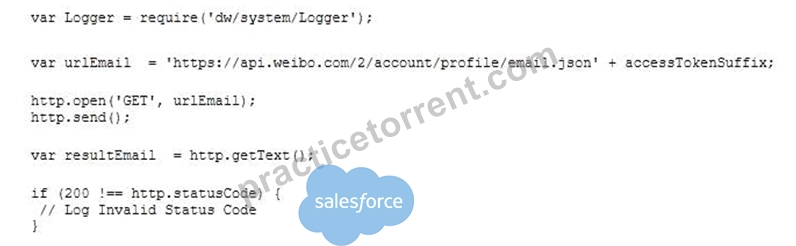
Which statement logs the HTTP status code to a debug-level custom log file?
- A. logger.debug("Error retrieving profile email, Status Code: {0} was returned.", http.statusCode);
- B. Logger.getLogger('profile').debug("Error retrieving profile email, Status Code: {0} was returned.",
http.statusCode); - C. logger.getLogger('profile').debug("Error retrieving profile email, Status Code: ", http.statusCode);
- D. Logger.getLogger().debug("Error retrieving profile email, Status Code: {0} was returned.",
http.statusCode);
Answer: B
Explanation:
In Salesforce B2C Commerce, logging is implemented via the Logger class available through the dw.system.Logger module. The correct way to log messages is to use the getLogger() method to retrieve an instance of a logger configured for a specific category, followed by one of the log level methods such as debug(). The logging statement must correctly format the message and include dynamic data like the HTTP status code.
In the options given:
* Option A incorrectly uses logger.getLogger() and the debug method does not properly format the message with the status code.
* Option B uses logger.debug() without obtaining a logger instance specific to a category which does not match the given syntax of dw.system.Logger.
* Option C lacks the specific category 'profile' needed for getLogger() method.
* Option D is correct because it uses Logger.getLogger('profile').debug(), which correctly references a specific logger category and uses the placeholder {0} for the status code. This matches the Salesforce Commerce Cloud's way of handling log messages with parameterized data.
NEW QUESTION # 64
A Digital Developer is asked to optimize controller performance by lazy loading scripts as needed instead of loading all scripts at the start of the code execution.
Which statement should the Developer use to lazy loadscripts?
- A. local include
- B. require () method
- C. $.ajax () jQuery method
- D. importPackage () method
Answer: B
Explanation:
To optimize controller performance by lazy loading scripts as needed, the best approach in a Salesforce Commerce Cloud environment is to use the require() method. This method allows scripts to be loaded dynamically at the time they are needed rather than at the start of the code execution, which can significantly improve performance by reducing the initial load time and resource consumption. The require() method is part of the CommonJS module specification implemented in the Rhino JavaScript engine used by Salesforce B2C Commerce. This method provides a standard way to include modular JavaScript files as needed during runtime, as detailed in the "Managing Scripts with require()" section of the Salesforce Commerce Cloud documentation.
NEW QUESTION # 65
A developer customized the Cart-Show controller route with a LINK cartridge that adds social media dat a. There is a new requirement to add a datalayer object to the Cart-Show controller route.
How should the developer achieve this to ensure that no code change will be needed if the client decides to remove the LINK cartridge?
- A. Append Cart-Show controller route in the client cartridge and add datalayer object to the viewData variable.
- B. Replace the Cart-Show controller route in client cartridge and add datalayer object to the viewData variable. Ensure that the client cartridge is on the left of the U.HK cartridge m cartridge path.
- C. Replace the Cart-Show controller route in client cartridge and add datalayer object to the viewData variable.
Answer: A
NEW QUESTION # 66
A job executes a pipeline that makes calls to an external system.
Which two actions prevent performance issues in this situation? (Choose two.)
- A. Disable multi-threading.
- B. Use synchronous import or export jobs
- C. Use asynchronous import or export jobs.
- D. Configure a timeout for the script pipelet.
Answer: C,D
Explanation:
In scenarios where a job executes a pipeline that makes calls to an external system, the following actions can help prevent performance issues: B. Configure a timeout for the script pipelet. Setting a timeout ensures that the job does not hang indefinitely if the external system does not respond within a reasonable timeframe. This prevents the pipeline from being blocked by a slow or non-responsive external service. D. Use asynchronous import or export jobs. Asynchronous jobs allow the main execution flow to continue without waiting for the external system's response, which can improve the overall performance of the system by not delaying other operations.
These actions are recommended within Salesforce Commerce Cloud for managing interactions with external systems efficiently, as detailed in the "Performance Best Practices" and "Asynchronous Processing" sections of the documentation.
NEW QUESTION # 67
In Log Center, a developer notes a number of Cross Site Request Forgery (CSRF) log entries. The developer knows that this happens when a CSRF token is either not found or is invalid, and is working to remedy the situation as soon as possible.
Which two courses of action might solve the problem? (Choose two.)
- A. Delete the existing CSRF whitelists in Business Manager
- B. Add csrfProtection.generateToken as a middleware step in the controller
- C. Extend the CSRF token validity to avoid timeouts
- D. Add the token in the ISML template
Answer: A,C
NEW QUESTION # 68
Universal Containers calls the following combination of products "The Basics" and sells the combination as a unique product ID:
One Model 103 container
Five Model 611 container
Tree Model 201 container
The Developer created these three products in the catalog.
What is the next step in Business Manager to create "The Basics" as a combination?
- A. In the Product Bundles module, create a bundle named "The Basics".
- B. In the Product Sets module, create a product set named "The Basics".
- C. In the Products module, create a product named "The Basics" and add the products to the Product Bundles tab.
- D. In the Products module, create a product named "The Basics" and add the products to the Product Sets tab.
Answer: C
Explanation:
References:
NEW QUESTION # 69
A Digital Developer extends a system object, Product, andadds a Boolean attribute, "sellable," to it.
Assuming "prod" is the variable name handling the product, what code can the Developer use to access it?
- A. prod.sellable
- B. prod.extended.sellable
- C. prod.custom.sellable
- D. prod.persistable.sellable
Answer: C
Explanation:
When extending a system object in Salesforce B2C Commerce, such as adding a new attribute to the Product object, custom attributes are accessed through the custom namespace. Therefore, if a Boolean attribute named
"sellable" is added to the Product object, it should be accessed as prod.custom.sellable. This approach is part of the platform's data customization framework, where custom provides a namespace for all user-defined extensions to system objects, ensuring that they do not conflict with existing system properties. Detailed usage and examples of accessing custom attributes can be found in the Salesforce Commerce Cloud Script API documentation under "System Object Types".
NEW QUESTION # 70
A developer is working on a new site for the U.S based on an existing Canadian site. One of the requirements is a change to the address form. The current Canadian form has an <options> list with the correct two-letter abbreviation for the provinces.
The U.S. requirements are to:
Have an <options> list withthe correct two-letter abbreviation for the states in place of the province field.
Set the U.S site locale.
Add the options list field definition to the XML file.
How should the developer set up the files before making the required edits?
- A. Create a new sub-folder in the forms folder. Name it US. Copy existing address.xml file inthe new folder.
- B. Create a copyof existing address.xml file in the default folder. Rename that file toadres_US.xml
- C. Create a new sub-folder in the forms folder. Name it en_US. Copy existing address.xml filein the new folder.
- D. Create a copy of existing address.xml file in the defaultfolder. Rename that file toaddress_en_US.xml
Answer: C
Explanation:
To accommodate the requirement of changing the address form for a U.S.-based site from a Canadian configuration, the appropriate setup is option D: Create a new sub-folder in the forms folder named en_US and copy the existing address.xml file into this new folder. This method is consistent with Salesforce B2C Commerce best practices for managing site-specific customizations and localizations. This structure allows the system to easily identify and apply the correct localization settings based on the site context, enabling the U.S.
site to use a specific form configuration that differs from the Canadian version by providing the correct two-letter state abbreviations in the <options> list.
NEW QUESTION # 71
A developer wants to create in Business Manager extension with the cartridge named plugin_vm_extension.
Which two steps should the developer take for the extension option to show up in Business Manager?Choose 2 answers:
- A. Activate a new code version for the Business Manager Site.
- B. Add the appropiate roles and permission to the user to view the business manager extension.
- C. Add plugin_bm_extension to the cartridge path under Storefront cartridge site path.
- D. Add plugin_bm_extension to the cartridge path under business manager cartridge site
Answer: A,D
Explanation:
NEW QUESTION # 72
Server.get('Show', consentTracking.consent, cache.applyDefaultCache, function (req,res,next){ Var Site = require('dw/system/Syte"); Var pageMetaHelpter = require('*/cartridge/scripts/helpers/pageMetaHelper'); pageMetaHelpter.setPageMetaTags(req.pageMetaData, Site.current); res.render('/home/homePage'); Missing code here
}, pageMetadata.computedPageMetadata);
The controller endpoint code snippet above does not work.
Which line of code should the developer use to replace line 6 and correct the problem?
- A. req.next();
- B. next();
- C. return res;C. res.next();
Answer: B
Explanation:
In the given controller endpoint code snippet, the correct code to replace the missing line 6 is next();. This instruction is essential in Salesforce B2C Commerce's controller scripts where middleware functions are used.
The next() function is a part of the middleware pattern in Node.js, which is also utilized in SFCC's server-side scripting. It signals the server to proceed to the next middleware function in the stack. Without calling next(), the request-response cycle will halt, and the server won't proceed to handle subsequent operations, which might include additional middleware or ending the response cycle, potentially causing the application to hang or not respond as intended.
NEW QUESTION # 73
UniversalContainers created a site export file from staging in the global export directory.
How should the Digital Developer update their sandbox using this staging site export file?
- A. Download the site export file and use UX Studio to transfer the data to the sandbox.
- B. Use the Site Development > Import & Export Business Manager module.
- C. Use the Site Development > SiteImport & Export Business Manager module.
- D. Perform a data replication from staging.
Answer: B
Explanation:
To update a sandbox environment using a site export file from staging, the Digital Developer should use the
"Import & Export" module located under Site Development in the Business Manager. This tool allows developers to import site export files directly into the sandbox environment. This method is efficient and ensures that the environment is updated with the latest staging configurations and data, which can include catalog data, site preferences, and other site-specific settings. This approach is preferred over data replication or manual file transfers, as it ensures a complete and consistent import of the site data.
NEW QUESTION # 74
......
The Salesforce Certified B2C Commerce Developer certification exam consists of 60 multiple-choice questions that need to be completed in 105 minutes. B2C-Commerce-Developer exam fee is $200, and a passing score of 68% is required to earn the certification. B2C-Commerce-Developer exam covers topics such as data modeling, site design and development, integration, and customization. Successful candidates are awarded the Salesforce Certified B2C Commerce Developer certification, which is valid for two years. Salesforce Certified B2C Commerce Developer certification demonstrates a high level of technical expertise and can help developers advance their careers in the eCommerce industry.
Salesforce B2C-Commerce-Developer certification exam assesses a candidate's ability to design and develop e-commerce solutions using the Salesforce B2C Commerce platform, including building customizations and integrations, implementing and configuring business logic, and optimizing site performance. Salesforce Certified B2C Commerce Developer certification is a valuable asset for developers who want to demonstrate their expertise in building e-commerce solutions using the Salesforce B2C Commerce platform and advance their careers in the e-commerce industry.
Pass Your B2C-Commerce-Developer Exam Easily With 100% Exam Passing Guarantee: https://pass4sure.practicetorrent.com/B2C-Commerce-Developer-practice-exam-torrent.html